Who was D.B. Cooper? The NORJAK FBI files on the unsolved hijacking
25,282 documents · Counts as of Nov 21, 2026
The FBI’s NORJAK files on the 1971 hijacking by the man known as D.B. Cooper.
TopicsCrime & Cold Cases
No one knows who D.B. Cooper was. The man who bought his ticket as Dan Cooper hijacked Northwest Orient Flight 305, a Boeing 727, on November 24, 1971, and jumped from the back of the plane with the ransom. The FBI never identified him, and in July 2016 it stopped actively investigating, saying no tip had led to “a definitive identification of the hijacker.” Two records in its NORJAK file are the ones people repeat. Two days after the hijacking, the rigger who packed the parachutes told agents the chest pack the hijacker took was a training dummy, its folds sewn together. And on February 10, 1980, about 290 of the ransom’s $20 bills turned up in the sand of the Columbia River, still in packets and in serial-number order. This cabinet holds 25,282 records from all 122 parts on the FBI Vault.
fbi-db-cooper:FBI-COOPER-P073-p00288, p. 1Full sizeFBI Vault: D.B. Cooper ↗- Released by
- Federal Bureau of Investigation, on the FBI Vault.
- Released
- Posted on the FBI Vault in stages: Parts 1 to 7 on December 6, 2010, then about one part a month from February 3, 2017. Part 122 was posted October 1, 2026.
- What’s inside
- Investigative records on the November 1971 hijacking of Northwest Orient Flight 305, the case the FBI called NORJAK. The Octopus Files holds 25,282 records from 44,238 pages, taken from all 122 parts.
- Our copy
- Downloaded from the FBI Vault’s D.B. Cooper page (Parts 1 to 122) on October 18, 2026, with the files unchanged.
- Supplements
- None None. Every record comes from the FBI Vault.
At a glance
110019002025
Every dated document is drawn; the axis breaks across long stretches with none. Dates as the catalog records them, counted Nov 19, 2026.
Who was D.B. Cooper?
He is still unidentified. The FBI’s history of the case describes “a nondescript man calling himself Dan Cooper” who paid cash for a one-way ticket and appeared to be in his mid-40s. A February 1972 FBI circular to every police agency described a white man of 5′10″ to 6′ and 170 to 180 pounds, and said: “The hijacker has not been identified and no trace has been found of him, the parachutes, or the money” (doc fbi-db-cooper:FBI-COOPER-P022-p00332, pp. 1–2).
Is the D.B. Cooper case solved?
No. On July 12, 2016, the FBI’s Seattle office announced that on July 8 it had “redirected resources allocated to the D.B. Cooper case in order to focus on other investigative priorities.” The announcement said the FBI would preserve the evidence at its headquarters and asked anyone with physical evidence about the parachutes or ransom money to contact their local FBI field office. The case sits in this archive beside the FBI’s files on the Zodiac Killer and Jimmy Hoffa, two more of the crime and cold-case cabinets.
The D.B. Cooper hijacking, in the FBI’s words
The FBI’s case summary runs like this. On November 24, 1971, the day before Thanksgiving, a lone man boarded Flight 305 at Portland, Oregon. At about 3:22 p.m., on the way to Seattle, he told the flight attendant his briefcase held a bomb. He demanded “$200,000.00 and four parachutes in exchange for the safety of the 36 passengers aboard the plane.” At Seattle the airline complied. Once he had the money and the parachutes, he let all the passengers and two flight attendants go, told the crew to fly toward Mexico City at a low altitude and slow speed so the rear door could be opened, and “apparently bailed out somewhere between Seattle and Reno” (doc fbi-db-cooper:FBI-COOPER-P077-p00249, p. 1).
D.B. Cooper money found at Tena Bar
For eight years none of the ransom cash surfaced. Then, the FBI’s Portland office later wrote, “On February 10, 1980, approximately 290 $20 bills were located in the sand of the Columbia River.” They were in packets and in serial-number order, but so decayed that the FBI Laboratory “could not determine exactly the number of bills” (doc fbi-db-cooper:FBI-COOPER-P097-p00020, p. 2). The FBI summarizes the find as about $5,800, found by a young boy. Its 1980 press release puts the spot on the north bank, about five miles downriver from the Interstate 5 bridge between Portland and Vancouver, Washington (doc fbi-db-cooper:FBI-COOPER-P043-p00127, p. 2).
How the money got there is the file’s best puzzle. A Portland State University geologist examined the sand layers after the discovery. He told agents the money had been found in the upper six to eight inches of sand, above a clay layer he thought came from 1974 dredging, and he thought river flow had probably carried it to the site (doc fbi-db-cooper:FBI-COOPER-P073-p00048, p. 1). In a follow-up he said that, at the height it was found, the money was “definitely deposited more than four years after the dredging” and had probably not been there more than a year. He pointed to the Washougal River’s drainage basin as the place it likely came from (doc fbi-db-cooper:FBI-COOPER-P096-p00308, p. 3). Only “a small part” of the loot has ever surfaced, the FBI said in 2007.
Was D.B. Cooper’s parachute ever found?
No parachute has been publicly confirmed as one of the two Cooper took. In 2016 the FBI asked anyone with relevant physical evidence to contact it. On November 26, 1971, the rigger told agents the missing back pack held a 28-foot white parachute, and that the missing chest pack was “a ground training pack dummied up to look like a good one,” its folds sewn together so it would not open in the training room (doc fbi-db-cooper:FBI-COOPER-P071-p00383, p. 1). A 1973 Seattle report said an experienced sport parachutist would probably have noticed the defect, and judged the hijacker no experienced jumper but probably someone with jump training “most probably obtained while in the military” (doc fbi-db-cooper:FBI-COOPER-P076-p00060, pp. 9–10).
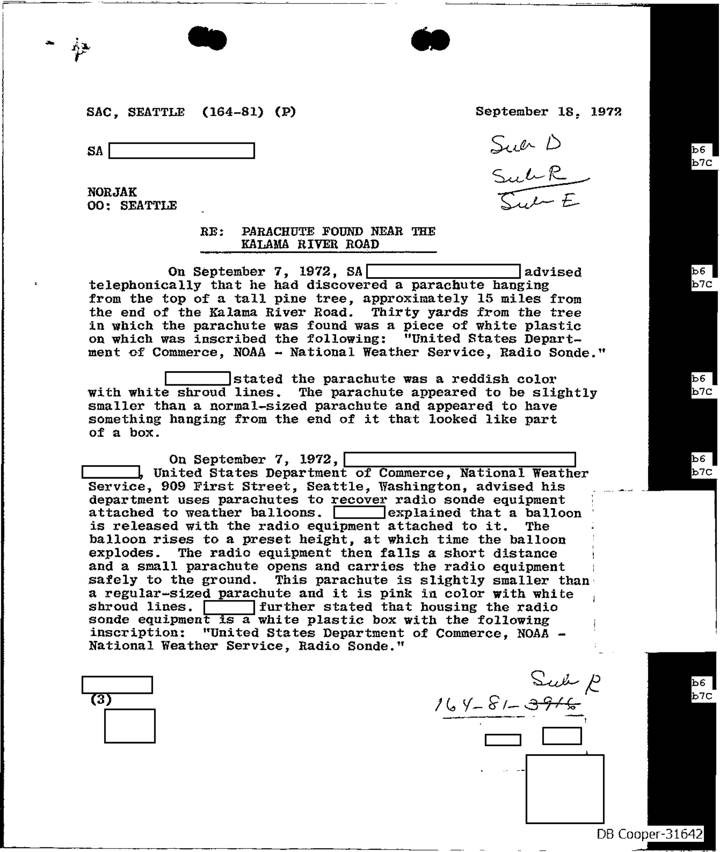
Parachutes found in the woods came in for years; of one found in 1979, an FBI spokesman said, “We have determined after examining the chute that it is not related” (doc fbi-db-cooper:FBI-COOPER-P078-p00383, p. 1). In December 1978 a Northwest Airlines employee examined a photo of a decal found near Castle Rock, Washington, and identified it as the type of Boeing 727 marker used beside the rear stairway’s emergency-exit handle (doc fbi-db-cooper:FBI-COOPER-P072-p00352, p. 1). The record says it came from the same type of aircraft, not that it came from the hijacked plane.
D.B. Cooper’s tie and the DNA
He left his tie on the plane. In February 1972 Portland sent the Laboratory “the man’s narrow black necktie with attached tie clip,” found in the aircraft, with a label exclusive to J.C. Penney (doc fbi-db-cooper:FBI-COOPER-P094-p00010, p. 1). In August 2001, the Seattle office requested DNA analysis of evidence including the snap-on tie and clip, saying earlier laboratory work had included no DNA testing (doc fbi-db-cooper:FBI-COOPER-P066-p00092, p. 1). The April 2, 2002 lab report found DNA from multiple people, including male DNA, in a combined tie-and-clip sample. It said the profile would be entered into CODIS, the national DNA index (doc fbi-db-cooper:FBI-COOPER-P066-p00087, p. 2). A later headquarters note says that in 2006 the Laboratory found the degraded sample “could only be used to exclude individuals” (doc fbi-db-cooper:FBI-COOPER-P052-p00284, p. 1).
Is D.B. Cooper still alive?
No one can say, but the FBI’s agents have long doubted he survived the jump. In the FBI’s December 2007 story, Seattle case agent Larry Carr said “he probably never even got his chute open.” A 2003 Seattle memo agrees: “it is very likely that the hijacker did not survive the jump, it remains a possibility” (doc fbi-db-cooper:FBI-COOPER-P101-p00123, p. 1).
D.B. Cooper suspects in the FBI file
The FBI says it had considered more than 800 suspects by the fifth anniversary. In its 2007 account it discussed three publicly named leads, and said of the names pegged as Cooper: “None have panned out.”
Richard Floyd McCoy Jr. hijacked United Air Lines Flight 855 on April 7, 1972, parachuted over Utah with $500,000 and was sentenced to 45 years (doc fbi-db-cooper:FBI-COOPER-P027-p00306, p. 4; doc fbi-db-cooper:FBI-COOPER-P052-p00189, p. 4). A 1992 Seattle memo contrasted McCoy’s age and eye color with the witnesses’ estimates and said all three flight attendants shown his photograph in 1972 were sure he was a different man (doc fbi-db-cooper:FBI-COOPER-P110-p00373, p. 2). The FBI’s 2007 account places McCoy in Utah the following day for Thanksgiving dinner, “an unlikely scenario unless he had help.”
Duane Weber. A 1997 FBI memo records a woman’s report that Duane Weber died in 1995 and had told her on his deathbed that he was Dan Cooper (doc fbi-db-cooper:FBI-COOPER-P051-p00159, p. 1). In 2007 the FBI said DNA testing had ruled him out.
Kenneth Christiansen, a 2004 tip told the FBI, had some parachuting experience in the military and was a Northwest Airlines flight attendant based in Seattle (doc fbi-db-cooper:FBI-COOPER-P052-p00174, p. 3). The FBI said in 2007 that Christiansen did not fit the physical description and was a skilled paratrooper.
Robert Rackstraw appears in a February 11, 1979 Associated Press story clipped into the file. It says he was questioned about the hijacking the year before, and adds: “The FBI says he no longer is a suspect” (doc fbi-db-cooper:FBI-COOPER-P054-p00157, p. 1). That is a newspaper’s report, not an FBI memo.
Example finds
- The ransom money in the sand. A 1982 Portland FBI letter says the bills found in 1980 were still in packets and in serial-number order, and lists the serial numbers the Laboratory could read.FBI Vault, D.B. Cooper Part 97 · doc
fbi-db-cooper:FBI-COOPER-P097-p00020, p. 2 · FBI Vault ↗ - A geologist’s theory about the ransom money. Three days after the find, a geologist told agents the money lay above a clay layer he thought came from 1974 dredging, and had probably been washed there by natural river flow.FBI Vault, D.B. Cooper Part 73 · doc
fbi-db-cooper:FBI-COOPER-P073-p00048, p. 1 · FBI Vault ↗ - The dummy parachute. The rigger who packed the chutes told agents the missing chest pack was “a ground training pack dummied up to look like a good one,” its folds sewn together.FBI Vault, D.B. Cooper Part 71 · doc
fbi-db-cooper:FBI-COOPER-P071-p00383, p. 1 · FBI Vault ↗ - DNA from the tie. The FBI Laboratory’s April 2, 2002 report found DNA from more than one person, including male DNA, on the tie and clip combined.FBI Vault, D.B. Cooper Part 66 · doc
fbi-db-cooper:FBI-COOPER-P066-p00087, p. 2 · FBI Vault ↗ - Why investigators ruled McCoy out. A 1992 Seattle memo sets McCoy, 28 with blue eyes, beside a hijacker described as 45 with brown eyes, and says all three flight attendants were “quite certain” he was not Cooper.FBI Vault, D.B. Cooper Part 110 · doc
fbi-db-cooper:FBI-COOPER-P110-p00373, p. 2 · FBI Vault ↗
How to search the D.B. Cooper files here
Sign up for the alpha. Once your invite arrives, open the D.B. Cooper FBI File cabinet, or tick it with any other cabinets, and search the text of all 122 parts by exact words, with AND, OR and NOT, or by meaning, to find passages about an idea even when the words differ. Each result lists a record that matched, with the matching passage when there is one; open it to read the record and its original scan. Ask Octopus can also answer a question in plain English, with citations to the records.
Related cabinets: the Zodiac Killer; Jimmy Hoffa; Black Dahlia; and every cabinet about crime and cold cases.
Questions about the D.B. Cooper files
Where did D.B. Cooper jump out of the plane?
No one knows the exact spot. The FBI’s 1980 Portland press release says the crew noticed a cabin pressure change as the plane passed over La Center, Washington, later taken to mark his exit through the rear stairwell door. The FBI’s 2007 account puts the jump between southern Washington and just north of Portland, Oregon.
What happened to the rest of D.B. Cooper’s money?
No one knows. Of the $200,000, the only cash found is the decayed $20 bills from Tena Bar in 1980, about $5,800 by the FBI’s count. In 2016 the FBI still asked anyone with physical evidence about the money to come forward.
Why is he called D.B. Cooper?
He bought his ticket as Dan Cooper. The FBI says the initials D.B. were apparently a myth created by the press; it questioned a man with those initials, but he was not the hijacker.
What plane did D.B. Cooper hijack?
Northwest Orient Flight 305 from Portland to Seattle, a Boeing 727. A 1978 FBI interview calls the 727 the type of aircraft used by Cooper, and the FBI’s 1980 press release says he had the crew fly south with the flaps and gear lowered and the rear stair door open.
Does the FBI have D.B. Cooper’s DNA?
The FBI recovered a mixture of DNA from the tie and clip. The laboratory reported more than one contributor, and the test did not establish whether any contributor was Cooper. A later FBI note says the degraded sample could only be used to exclude people. In 2007 the FBI said DNA testing had ruled out Duane Weber.
What does NORJAK mean?
NORJAK, for Northwest Hijacking, is the FBI’s name for the D.B. Cooper case. The FBI posted the NORJAK file on the FBI Vault in 122 parts.
Background drawn from each release’s official pages and our intake records, written October 24, 2026; counts in the facts above are from that day. The guide draws on the official release pages and on the records in this cabinet, checked November 21, 2026; its cabinet count is from the archive as of November 21, 2026.