JFK Files: what the released assassination records show
73,627 documents · Counts as of Nov 21, 2026
National Archives records on the assassination of President John F. Kennedy and the investigations that followed.
TopicsAssassinationsSpying & Surveillance
The JFK files are the National Archives’ President John F. Kennedy Assassination Records Collection, more than six million pages. Among these declassified JFK assassination files, a 1975 CIA memo explains how a photograph of another man was sent to the FBI in the mistaken belief it showed Lee Harvey Oswald, and a December 1963 CIA cable discusses keeping telephone taps out of what the Warren Commission was told. The files do not settle who was behind the assassination: the Warren Commission found no credible evidence that Oswald was part of a conspiracy, and the House Select Committee on Assassinations later concluded that one was probable but could not identify another gunman. This cabinet holds 73,627 documents from NARA’s releases from 2017 to January 2026.
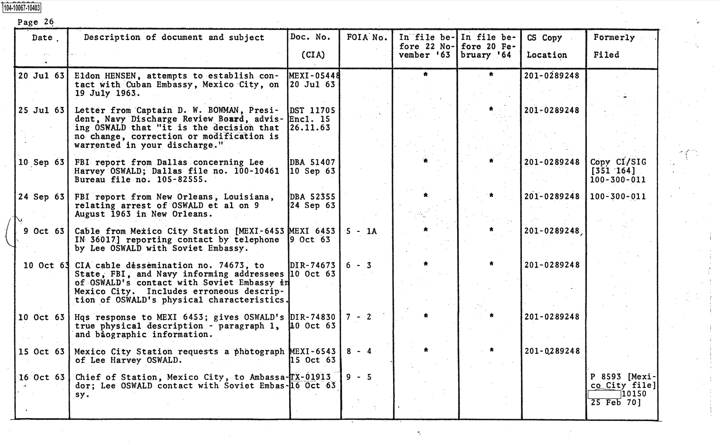
jfk-nara:a50ab20dad937d99a844cddbe64bf66bb0157b72801a9e455c7a0df5cb39dd48, p. 1Full sizeNARA: JFK Assassination Records ↗- Released by
- National Archives and Records Administration, under the President John F. Kennedy Assassination Records Collection Act of 1992.
- Released
- In stages after the Act was signed on October 26, 1992. The releases in this cabinet ran from July 24, 2017 to April 26, 2018, then on December 15, 2021, December 15, 2022, April 13 to August 24, 2023, from March 18, 2025, and on January 30, 2026.
- What’s inside
- CIA, FBI and other agency files, Warren Commission and House Select Committee material, and records of the Assassination Records Review Board. The Octopus Files holds 73,608 documents (774,565 pages), by release year: 2017 (34,842), 2018 (18,726), 2021 (1,484), 2022 (13,186), 2023 (2,693) and 2025, with the January 30, 2026 batch NARA lists on the same page (2,677). Nineteen audio files and two PDFs from the same downloads are not in the cabinet.
- Our copy
- From NARA’s own downloads, collected September 26–27, 2026: the release ZIP files on archives.gov for 2017 to 2023 and the 2025 files from the National Archives Catalog. Titles and dates come from NARA’s release spreadsheets.
- Supplements
- None None. Every file comes from NARA.
At a glance
190419402004
Every dated document is drawn; the axis breaks across long stretches with none. Dates as the catalog records them, counted Nov 19, 2026.
What the JFK files are
The President John F. Kennedy Assassination Records Collection Act, signed on October 26, 1992, put all assassination-related material in one collection at the National Archives and set up the Assassination Records Review Board to rule on agencies’ requests to keep records closed. NARA says the Act required every record to be opened by 2017, except those the President certified for further postponement.
NARA’s JFK page describes “over six million pages of records, photographs, motion pictures, sound recordings, and artifacts.” It says 88% of the collection was open in full by the late 1990s; the releases since 2017 are files agencies had withheld in whole or in part.
When were the JFK files released?
In stages. On January 23, 2025, Executive Order 14176 called for releasing the records on the assassinations of President Kennedy, Senator Robert F. Kennedy and Dr. Martin Luther King Jr.; the other two collections are the RFK Records and MLK Records cabinets. NARA says that from March 18, 2025, following the President’s directive of March 17, the collection’s records previously withheld for classification became available online or in person, and it kept posting scans after that.
| Release | Dates | What NARA lists |
|---|---|---|
| 2017–2018 | Seven batches, July 24, 2017 to April 26, 2018 | From 676 to 18,731 documents a batch |
| 2021 | December 15, 2021 | Records due for disclosure by that date |
| 2022 | December 15, 2022 | Records due for disclosure by that date |
| 2023 | Six batches, April 13 to August 24, 2023 | Remaining redactions reviewed in 3,648 documents |
| 2025 | March 18 to April 3, 2025 | 31,419 pages and then 37,127 more on March 18; three smaller postings after |
| 2026 | January 30, 2026 | 11,022 pages in 140 PDF files |
NARA gives the January 2026 batch’s size, not its subjects. Copies from it carry a “2026 RELEASE” line, as on CIA record 104-10174-10068 (doc jfk-nara:41786552e0f94d3f061424bfd8346aff7dd5878dc2f71694eb918c5829d4e2e1, p. 1). They are in this cabinet; the facts above count them with 2025.
Is anything in the JFK files still withheld?
Yes, in part. NARA’s 2025 page says FBI records transferred to it in 2025 were released “to the fullest extent possible,” with grand jury information redacted under section 10 of the Act, and that the CIA may keep withholding parts of its Mexico City Station History that do not relate to the assassination; everything in it about the assassination is public. NARA also says the March 2025 records were released without redactions, and that it is working with the Social Security Administration to protect living people whose personal identification information is in them.
What did the JFK files reveal?
The records below trace how the CIA reported contacts at the Soviet and Cuban embassies in Mexico City in 1963, and how it later discussed sharing that intelligence with the Warren Commission. None of them names another gunman or solves the case. Many are CIA documents; the agency’s wider declassified archive is the CIA CREST cabinet, and other surveillance records are gathered under spying and surveillance.
The day after the assassination, the FBI’s legal attache in Mexico City sent Dallas information from the CIA: on October 1, 1963, a man calling the Soviet Embassy from the Cuban Embassy, “speaking very bad Russian,” identified himself as Lee Oswald and asked about a telegram sent to Washington. Attached were photographs of a man the CIA thought might be the caller (FBI record 124-10230-10430, doc jfk-nara:21df2a1fb450830195f25bad983a9293d79771e21ea836da894ac604346798d8, pp. 1–2).
That man was not Oswald. A 1975 review of Oswald’s CIA file, done for a Freedom of Information request, says that the station had sent the photo to the FBI “in the mistaken assumption” it showed him. When the Warren Commission wanted it in its report, the CIA allowed it with the background “completely blocked out” and an agreement that no mention would be made of where it was taken. The memo says the Mexico City phone tap was “still active,” and that every mention of the photo was marked to be withheld from the 1975 release (CIA record 104-10061-10393, doc jfk-nara:10fb598107951bd3ef28d538e9f76c88a24918f03a3fb83f1227ed09f8a9fd1e, pp. 2–3).
The cable itself, DIR 90466, is here. Dated December 21, 1963 on this copy, it tells the Mexico City station: “Our present plan in passing info to Warren Commission is to eliminate mention of telephone taps, in order protect your continuing ops” (CIA record 104-10404-10132, doc jfk-nara:4211f337ee3914e3c2534ae333ceddab0b1a8ff4f921eecfd4488d4ee9197a0d, p. 2). A House Select Committee staff draft quotes it and argues that the CIA was “successful for over three months” in keeping its surveillance from the Warren Commission staff working on the trip; that is the staff’s reading (HSCA record 180-10142-10064, doc jfk-nara:9c262fa9a499fb4f29d0b0fa08d2f38775a09bb2070e9c107f5dd5a978fb7cca, p. 44). The CIA’s own 1977 comments say its headquarters desk “neglected, for unknown reasons,” to include Oswald’s September 28 visit to the Soviet Embassy in the report it sent to its recipients (CIA record 104-10422-10277, doc jfk-nara:d3afb3f8ec902390172513698e8947e222935a3f8cf8305ae59a130e45881e40, p. 189).
The House Select Committee records
The House Select Committee on Assassinations was created on September 17, 1976, investigated the deaths of President Kennedy and Dr. King, and published its report on March 29, 1979. A 1993 report says its records had been scheduled to open in 2029; the 1992 Act made them available earlier (CIA record 104-10333-10010, doc jfk-nara:4ba990193b223280ab847145eb60a3429af40fe2e321ae50415ed9f733e8b91d, p. 266).
NARA’s reproduction of the committee’s 1979 summary of findings, filed here with an FBI legal counsel memo, says Oswald fired three shots and that the third killed the President. It says “scientific acoustical evidence establishes a high probability that two gunmen fired,” that Kennedy “was probably assassinated as a result of a conspiracy,” and that the committee was “unable to identify the other gunman or the extent of the conspiracy.” It found that the Soviet and Cuban governments were not involved (FBI record 124-10191-10043, doc jfk-nara:b9c76243dc092a14ae371fdaebd592cfd47b9364de81016b3f0510f5ad1f8d1b, p. 21). That is the committee’s 1979 conclusion, and the acoustic evidence was later challenged. A 1993 ABC News transcript filed in CIA records has the author Gerald Posner saying the National Academy of Sciences “reviewed their work later, and pointed out all the flaws in it” (CIA record 104-10332-10009, doc jfk-nara:152e30c30ce5c226d1e8f840093c59c516b8851fefc34bc78627d821ee73b951, p. 68). The cabinet holds that account of the review, not the review itself.
The NSA’s file of its contacts with the committee holds a handwritten phone message of December 9, 1977: the committee’s deputy chief counsel called to say a letter was coming that would ask for “certain information (unspecified)” (NSA record 144-10001-10217, doc jfk-nara:459e797598612355b76f81612ca49e444764588abb2adbce380cc399a14757fc, p. 11).
The JFK files and the autopsy
The autopsy report itself is public: NARA provides it as Appendix IX of the Warren Commission report (Commission Exhibits 387 and 391). A February 24, 1978 letter from the committee’s chief counsel, G. Robert Blakey, asks Burke Marshall for authorization to enhance selected autopsy photographs of the head, back and neck held at the National Archives, at three laboratories, with Archives staff in “constant visual contact” (HSCA record 180-10116-10318, doc jfk-nara:bccc518365eb3d43d99157de3366c56251c35f1fc89cdb1ea22a3ed8f246a17c, pp. 129–130). A Defense Department fact sheet sent to Blakey in June 1978 says the X-ray unit used at the autopsy “is no longer in use and after a search could not be located” (HSCA record 180-10104-10354, doc jfk-nara:f4787a7db74dcc6f736c25b7bff6d90d12ca586898e4b62edc43943a28c26569, pp. 1, 21). These are the request and the reply, not the photographs.
What’s new in the 2025 and 2026 JFK files
One March 2025 copy, filed in the Johnson Library’s intelligence file on Oswald, is a Top Secret cable of November 26, 1963, listed as a CIA record on its form, with a DIRNSA header. It relays a November 25 message from Havana to Cuba’s mission at the United Nations with the foreign ministry’s press note: Oswald asked for a transit visa at the Cuban consulate in Mexico City on September 27, “the said visa was never granted,” and the assassination was a provocation planned by “the most reactionary sectors” of the United States. That is the Cuban government’s claim (LBJ record 177-10001-10033, doc jfk-nara:a5c01421869d99e630b66f5edd8874d8a1f08f6ab0143e7a7a248663568a019a, pp. 1, 3–4).
Another is a 1982 exchange. In a May 10 letter, another government’s intelligence service asks the CIA about Valeriy Kostikov, a Soviet official it calls KGB who served in Mexico City, and about a book’s claim that he was Oswald’s KGB case officer (CIA record 104-10012-10024, doc jfk-nara:ade8972b4524b639770ef1ac98570bd74b2da8a9bc354d8dcefd5991cec7b517, p. 1). The CIA replies that Kostikov, as a consular officer, handled Oswald’s visa request, and that it has “no information which indicates any relationship” beyond that. Its file indicates he may have been a member of “Department 13 (Executive Action),” it adds, which it had been unable to confirm (CIA record 104-10431-10091, doc jfk-nara:f365fe78749dc8bfc9d967b387dd3e0f89a42bd868335bc486bd0c1e72c5be39, pp. 1–2).
George Joannides, the CIA officer many readers look for, appears in a 1998 CIA memo here that names him as case officer for the DRE (Directorio Revolucionario Estudiantil) “during the period before and after the Kennedy assassination” and says five of his fitness reports were designated assassination records (CIA record 104-10336-10020, doc jfk-nara:d30b723dd39ebaf15ed5fc0a5b91e565b729430bc4d6ff4156371f76e46d7626, p. 10).
Example finds
- The “mystery man” photo. A 1975 CIA review says the agency sent the FBI a photo of a different man, and agreed to its printing with the background obscured and the location left out.CIA record 104-10061-10393 · doc
jfk-nara:10fb598107951bd3ef28d538e9f76c88a24918f03a3fb83f1227ed09f8a9fd1e, pp. 2–3 · NARA PDF ↗ - “Eliminate mention of telephone taps.” CIA headquarters’ December 1963 cable to Mexico City on what the Warren Commission would be told.CIA record 104-10404-10132 · doc
jfk-nara:4211f337ee3914e3c2534ae333ceddab0b1a8ff4f921eecfd4488d4ee9197a0d, p. 2 · NARA PDF ↗ - The House committee’s 1979 findings. The summary that found a conspiracy “probable” on acoustic evidence of a second gunman it could not identify.FBI record 124-10191-10043 · doc
jfk-nara:b9c76243dc092a14ae371fdaebd592cfd47b9364de81016b3f0510f5ad1f8d1b, p. 21 · NARA PDF ↗ - The autopsy X-ray unit. A June 1978 Defense Department fact sheet says the X-ray unit used at the autopsy could not be found.HSCA record 180-10104-10354 · doc
jfk-nara:f4787a7db74dcc6f736c25b7bff6d90d12ca586898e4b62edc43943a28c26569, p. 21 · NARA PDF ↗ - Havana’s answer, three days after. A Top Secret cable relays Cuba’s November 25, 1963 statement that Oswald was never granted a transit visa, and its claim of a provocation.LBJ record 177-10001-10033 · doc
jfk-nara:a5c01421869d99e630b66f5edd8874d8a1f08f6ab0143e7a7a248663568a019a, pp. 3–4 · NARA PDF ↗ - The KGB question. The CIA’s 1982 reply on Valeriy Kostikov, the Soviet consular officer who handled Oswald’s visa request.CIA record 104-10431-10091 · doc
jfk-nara:f365fe78749dc8bfc9d967b387dd3e0f89a42bd868335bc486bd0c1e72c5be39, p. 1 · NARA PDF ↗
How to search the JFK files here
Sign up for the alpha. Once your invite arrives, open the JFK Records cabinet, or tick it with any other cabinets, and search by exact words, with AND, OR and NOT, or by meaning, to find passages about an idea even when the words differ. Open a result to read the record and its original scan. We re-read hard pages from the scans, so handwritten notes can be searched: try the phrase “certain information (unspecified)” from the 1977 NSA phone message. Ask Octopus can also answer a question in plain English, with citations to the records.
Related cabinets: the other assassination cabinets, RFK Records and MLK Records; CIA CREST, the CIA’s own declassified archive; and every cabinet about assassinations or spying and surveillance.
Questions about the JFK files
Who killed JFK, according to the released files?
The files hold the official findings, not a new answer. The Warren Commission concluded that the shots which killed President Kennedy were fired by Lee Harvey Oswald. The House Select Committee on Assassinations agreed in 1979 that Oswald fired the shots that struck Kennedy, but said a second gunman, whom it could not identify, probably fired too.
Do the JFK files prove there was a conspiracy?
No. The Warren Commission found no credible evidence of one. The House committee concluded in 1979 that a conspiracy was probable, based in part on acoustic evidence, but could not identify the other gunman or the extent of the conspiracy. That acoustic evidence was later challenged; records in the cabinet quote the author Gerald Posner saying a National Academy of Sciences review found flaws in it.
What was in the January 2026 JFK files release?
NARA lists 11,022 pages in 140 PDF files, posted January 30, 2026, without describing their subjects. Copies from that batch carry a “2026 RELEASE” line, and this cabinet holds them.
Do the JFK files include the autopsy?
They include records about it. NARA provides the autopsy report itself as Appendix IX of the Warren Commission report. The House committee’s files hold its 1978 request to enhance autopsy photographs at the National Archives and a Defense Department fact sheet saying the X-ray unit used at the autopsy could not be found. They are not the photographs.
Why are some JFK files still redacted?
The 1992 Act lets some information stay protected after the other postponements end: section 10 covers material under court seal or grand jury secrecy, and section 11 covers tax return information and records deeded to the government by a private citizen. NARA cites section 10 for the grand jury redactions in FBI records transferred in 2025.
How many JFK documents does The Octopus Files hold?
73,627 documents from NARA’s JFK releases from 2017 to January 2026. The facts above break the count down by release year, with the January 2026 files counted under 2025.
Background drawn from each release’s official pages and our intake records, written October 24, 2026; counts in the facts above are from that day. The guide draws on the official release pages and on the records in this cabinet, checked November 21, 2026; its cabinet count is from the archive as of November 21, 2026.