RFK assassination: who killed RFK, and what the 2025 files show
23,056 documents · Counts as of Nov 21, 2026
National Archives records on the assassination of Senator Robert F. Kennedy, released in 2025.
TopicsAssassinationsSpying & Surveillance
A jury convicted Sirhan Bishara Sirhan in 1969 of murdering Senator Robert F. Kennedy, who was shot at the Ambassador Hotel in Los Angeles at about 12:15 a.m. on June 5, 1968. The declassified 2025 RFK assassination files hold the records behind that verdict and the doubts that followed. An FBI memo quotes notebooks from Sirhan’s room: “RFK must die” and “Robert F. Kennedy must be assassinated before 5 June 68.” In 1975 seven firearms examiners found no substantive evidence that more than one gun fired the bullets they examined, though the tests could not link every bullet to Sirhan’s revolver. This cabinet holds all 84,524 released pages, divided into 23,056 documents you can search.
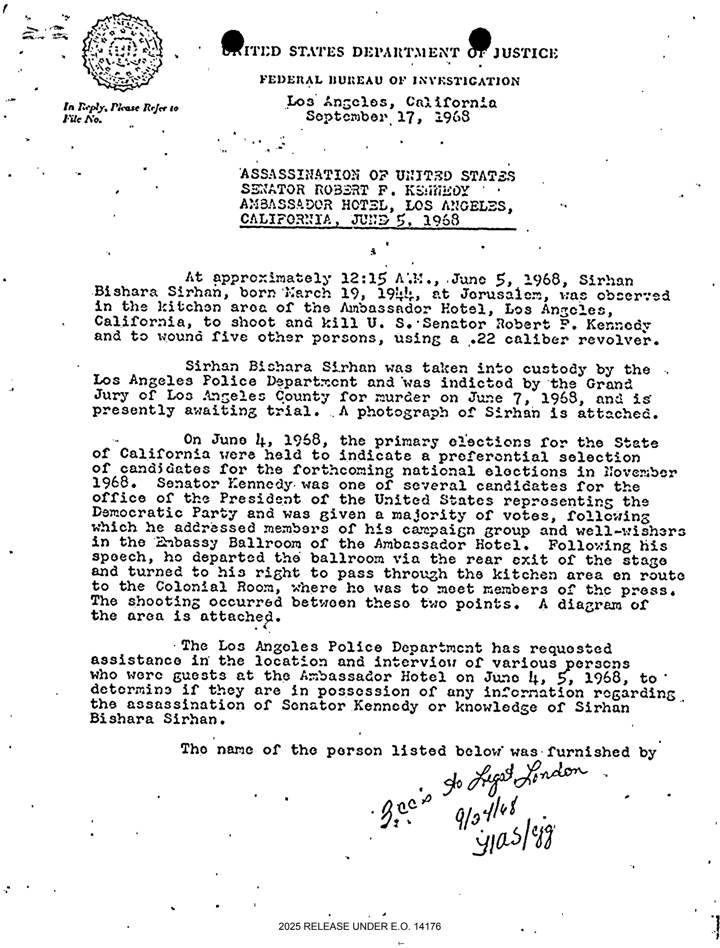
74afb9cbaee528f661fef39b072b0181e8fe219e27df7cfde2075b862ef0c156-p03110-03121, p. 11Full sizeNARA: RFK Assassination Records ↗- Released by
- National Archives and Records Administration, under Executive Order 14176.
- Released
- In 2025, in the release folders NARA dated April 18, May 7 and June 12. Executive Order 14176, signed January 23, 2025, called for plans to release the records on the assassinations of President Kennedy, Senator Robert F. Kennedy and Dr. King.
- What’s inside
- 23,056 records cut from 1,969 files (84,528 pages): the 1,965 PDFs NARA released (84,524 pages) and four one-page copyright notices posted with them. Files by release folder: April 18 (229 files), May 7 (1,503) and June 12 (237). The 13 audio recordings NARA posted are not in the cabinet, and four more listed recordings were not online.
- Our copy
- From NARA’s RFK release page, downloaded November 11, 2026. Most pages keep the text NARA published with the scans. The 4,977 pages that had none and carry writing were read with OCR (Apple Vision); 102 picture or blank pages have no text. Each file was then divided into the records it holds, and each record titled and dated from its own text, by Claude Haiku 5.5; those titles and dates are model-written and unreviewed.
- Supplements
- None None. Every file comes from NARA.
At a glance
19322025
Every dated document is drawn. Dates as the catalog records them, counted Nov 19, 2026.
Who killed RFK?
Sirhan Bishara Sirhan was convicted of the murder. An FBI file’s narrative of the night, drawn from local news reports, says Kennedy had just given an election victory speech and was leaving through a kitchen exit when the gunman “fired a series of shots in rapid succession, injuring five other individuals.” Roosevelt Grier and Rafer Johnson seized him and took a .22 caliber revolver from him. Kennedy died at 1:44 a.m. on June 6 (doc 74afb9cbaee528f661fef39b072b0181e8fe219e27df7cfde2075b862ef0c156-p00007-00011, pp. 2–3). Another FBI narrative gives the cause of death as a “gunshot wound of the right mastoid, penetrating the brain,” and, from the autopsy summary, the fatal bullet’s direction as “right to left, slightly to the front and upward” (doc 3af9a871d21e0f902462ba6b7d760bec2e22f15d43619762e4c7b60342616918, p. 44).
The FBI’s Los Angeles office reported that the jury found Sirhan guilty of first-degree murder and of “assault with a dangerous weapon with intent to commit murder” on five other counts, and that he was sentenced to death in May 1969 (doc b6c844e36c934f3cb3bc5aa4a6cf6fd20a1f8e3a5e7de9690a534fc87cce3f8d-p00039-00050, p. 4). Thomas F. Kranz, appointed special counsel by Los Angeles County in 1975, wrote in his March 1977 report that the California Supreme Court changed the sentence to life imprisonment. Later appeals had been denied by the time he wrote, including a January 1975 application alleging that “two guns had been fired at the murder scene” (doc d053fdc7800cff50443f05f799a476d369ab99490d0c138a6e73fc118427cc4f-p00003-00049, pp. 2, 5).
During the trial, Sirhan tried to plead guilty. A weekly trial summary in the FBI’s files relays a newspaper’s account: asked by Judge Walker for a reason, Sirhan replied, “I killed Robert F. Kennedy willfully, premeditatedly, with 20 years of malice aforethought, that is why.” The judge refused the plea (doc 2280769a24371a865a3960c51a876c8bf374daed145e2790152283073eb4c49c-p00017-00029, pp. 1, 11).
Sirhan’s notebooks: “RFK must die”
A June 11, 1968 FBI memo reports that the Los Angeles Police Department gave the Bureau two large spiral notebooks, one small one and 11 loose items from Sirhan’s room. It quotes a page dated “May 18 9:45 a.m. 68”: “My determination to eliminate RFK is becoming more the more of an unshakable obsession.” The writer “repeatedly states ‘RFK must die – RFK must be assassinated, etc.’” and near the end, “Robert F. Kennedy must be assassinated before 5 June 68” (doc d164f95a2d8a4582f37c79241b098c026ceac75edbdc6218b4eebf546a849d76-p00032-00034, p. 1).
Was there a second gun? What the records say
The later firearms review asked how many bullets were fired and what the recovered bullets could prove. The Kranz report gives the police account: the final analysis “was that only eight bullets had been fired at the crime scene and that Sirhan had fired all eight bullets,” seven recovered and the eighth “lost somewhere in the ceiling inner space” (doc 94e458602c9e5ff3befe6d4e800dca85103e064559d2b1a9484524f2322e9e57, p. 15).
Against that count stood photographs of circled holes in the pantry’s door frames, and an FBI photographer’s one-page report of June 9, 1968 describing “four reported bullet holes” around the swinging doors. The police criminalist testified that police circled every hole in the kitchen area as a matter of course and found no bullets or fragments in the door-frame boards (pp. 14–15). Kranz found no other reference to the photographer’s claim in the FBI’s 803-page release, and interviews with FBI investigators produced no ballistics evidence to substantiate it (p. 15).
In 1975, on petitions by CBS and by Paul Schrade, one of the five wounded, a court ordered the evidence re-examined. On October 6, 1975, seven firearms examiners reported “no substantive or demonstrable evidence to indicate that more than one gun was used to fire any of the bullets examined” (doc 94e458602c9e5ff3befe6d4e800dca85103e064559d2b1a9484524f2322e9e57, p. 20). Kranz notes the limit: with the barrel in a “severe leaded condition,” the test firing “actually added very little,” and the similarities were “not of a sufficient number to positively link all the bullets with the Sirhan weapon itself” (doc c62a806dc529f69bddafb16f46760e0f68fd5fe5a4f4eb4750948c25bdce06fc-p00001-00041, p. 39).
The May 2025 release also holds a September 25, 2012 letter in which Robert F. Kennedy Jr. asked Attorney General Eric Holder to honor Schrade’s request for a new investigation. Schrade’s enclosed request says a new analysis of a journalist’s audiotape shows “at least 13 shots” (doc ab6b3b550d75fca813b3c47fce56e8bd0851827802249ebb4f9a49552bad2799, pp. 1–2). That is the requesters’ claim; these records hold no official finding on the tape.
What are the RFK files released in 2025?
Executive Order 14176, signed January 23, 2025, directed officials to plan the “full and complete release” of records on the assassinations of Senator Kennedy, President John F. Kennedy and Dr. Martin Luther King Jr. NARA’s RFK page lists three releases:
| Release | Size | What NARA’s notes say | A record from it |
|---|---|---|---|
| April 18, 2025 | 10,185 pages, 229 PDFs | Black-and-white scans, with color where pages were not legible | FBI report on the verdict |
| May 7, 2025 | 64,686 pages, 1,499 PDFs, 17 MP3s | FBI Los Angeles evidence files from KENSALT, and 1976 FOIA copies | FBI memo on the notebooks |
| June 12, 2025 | 9,653 pages, 237 PDFs | Johnson and Ford libraries, State Department, and CIA documents, 148 released before in the JFK collection | CIA memo on Robert Kennedy, 1955 |
The girl in the polka-dot dress
One witness described a young woman in a polka-dot dress running from the hotel. The Los Angeles Police Department’s Investigation Summary, Volume IV, records her account that the woman was yelling “We shot him, we shot him,” and, asked who, answered “Kennedy, we shot Kennedy.” The summary concludes that a polygraph examination “disclosed” that the witness had never seen Sirhan in person and had “fabricated, for some unknown reason, the story.” After she was “interrogated extensively,” it says, she admitted the story “was not true” (doc e102481d5c109e46dce202181145f64e8730c11927a04f1d473a25dadccb9abb-p00004-00043, p. 15). That conclusion is about this one witness. Other polka-dot mentions in the files are separate tips and statements.
What the CIA records say
On June 5, 1968, a CIA cable to the FBI, the White House Situation Room and others said “a preliminary search of agency records has yielded no information” on the suspect (doc e37392f1bf056deea8925b54009583ec93fa20cbc49f66680f20757b2aba5d8f-p00318-00322, p. 4). A memorandum of October 31, 1975 says Sirhan’s security file “reflects that he had never been of interest to the Agency prior to the assassination,” and that the CIA offered the Los Angeles police help on condition that nothing could be attributed to it or made public. A police inspector agreed, “stating that the LAPD felt that it already had an airtight case against Sirhan” (doc 5136ef4fe976994ed6f34bb63888e4e816ec2a008811d50fa292dd86c7316bed-p00002-00005, p. 3).
The June release also holds the CIA’s file on Robert Kennedy himself. A July 20, 1955 memorandum records a CIA officer briefing Kennedy, then a Senate committee staffer, before his trip to the USSR with Justice William O. Douglas: “He proved to be a good listener and serious about the task he is to perform for CIA” (doc 85a879b410e55bcb1430243a63ad2a9fc1291f831363da7cf42ded29777e2455-p00115-00115, p. 1). More CIA records are in the CIA CREST cabinet.
An unsigned handwriting study
The June release also holds an unsigned “Personality Assessment of Sirhan Sirhan,” drawn from his handwriting and diary. Its pages do not say who wrote it. The authors write that “under no circumstances would we have predicted that he was ‘capable’ of doing what he did,” and: “Obviously, we cannot see him as part of a conspiracy.” They allow that he “could be a tool of a conspiracy,” then call it “very unlikely however that he could have effectively acted under precise instructions” (doc af59a6b469ac17685ca3101e9a97d615398789154846976d5120562395d81481, p. 1).
Example finds
- “RFK must die.” The FBI’s summary of Sirhan’s notebooks quotes a page dated May 18, 1968, 18 days before the shooting, that calls the writer’s determination to “eliminate RFK” an “unshakable obsession” and sets a deadline: “before 5 June 68.”FBI file 62-HQ-587, Section 5, Part 4 of 5 · doc
d164f95a2d8a4582f37c79241b098c026ceac75edbdc6218b4eebf546a849d76-p00032-00034, p. 1 · NARA PDF ↗ - The 1975 firearms panel. Seven examiners reported no substantive or demonstrable evidence that more than one gun fired the bullets they examined. The special counsel’s report records the limit: the tests could not positively link every bullet to Sirhan’s revolver.Special counsel’s report, FBI file 62-HQ-587, EBF 1336, Part 2 of 6 · doc
94e458602c9e5ff3befe6d4e800dca85103e064559d2b1a9484524f2322e9e57, p. 20 · NARA PDF ↗ - “Four reported bullet holes.” The special counsel’s report traces the four-holes claim to an FBI photographer’s one-page report and says no ballistics evidence was found to substantiate it.Special counsel’s report, FBI file 62-HQ-587, EBF 1336, Part 2 of 6 · doc
94e458602c9e5ff3befe6d4e800dca85103e064559d2b1a9484524f2322e9e57, pp. 14–15 · NARA PDF ↗ - The polka-dot dress. The police summary records what one witness first told investigators about a woman shouting “we shot Kennedy,” and says she later admitted it was not true.LAPD Investigation Summary, Vol. IV, in FBI file 56-LA-156, Section 2, Part 1 of 7 · doc
e102481d5c109e46dce202181145f64e8730c11927a04f1d473a25dadccb9abb-p00004-00043, p. 15 · NARA PDF ↗ - “Never been of interest to the Agency.” A 1975 CIA memo says Sirhan’s security file showed no agency interest in him before the assassination, and sets out the terms on which the CIA offered to help the Los Angeles police.CIA memorandum, “Sirhan Sirhan Investigation,” October 31, 1975 · doc
5136ef4fe976994ed6f34bb63888e4e816ec2a008811d50fa292dd86c7316bed-p00002-00005, p. 3 · NARA PDF ↗ - Robert Kennedy’s own CIA file. A July 1955 memo records a CIA officer briefing Kennedy before his trip to the USSR and calls him “serious about the task he is to perform for CIA.”CIA file on Robert F. Kennedy, memorandum for the record, July 20, 1955 · doc
85a879b410e55bcb1430243a63ad2a9fc1291f831363da7cf42ded29777e2455-p00115-00115, p. 1 · NARA PDF ↗
How to search the RFK files here
Sign up for the alpha. Once your invite arrives, open the RFK Records cabinet, or tick it with any other cabinets, and search by exact words, with AND, OR and NOT, or by meaning, to find passages about an idea even when the words differ. Try the FBI caption KENSALT, or the phrase “polka dot dress.” We read pages that had no text with OCR, so typed reports and teletypes can be searched. Open a result to read the record and its original scan. Ask Octopus can also answer a question in plain English, with citations to the records.
Related cabinets: the other 2025 assassination releases, JFK Records and MLK Records; CIA CREST, the CIA’s own declassified archive; COINTELPRO, the FBI’s programs against political groups; and every cabinet about assassinations.
Questions about the RFK assassination files
Was there a second gunman in the RFK assassination?
A court-ordered panel of seven firearms examiners reported on October 6, 1975, “no substantive or demonstrable evidence to indicate that more than one gun was used to fire any of the bullets examined” (doc 94e458602c9e5ff3befe6d4e800dca85103e064559d2b1a9484524f2322e9e57, p. 20). The special counsel added that the similarities were “not of a sufficient number to positively link all the bullets with the Sirhan weapon itself” (doc c62a806dc529f69bddafb16f46760e0f68fd5fe5a4f4eb4750948c25bdce06fc-p00001-00041, p. 39). The police account was that Sirhan fired all eight bullets.
Why did Sirhan shoot RFK?
These records answer it through the prosecution’s case. The state’s brief on his appeal, which the FBI received in 1971, summarizes a psychiatrist’s trial testimony: in Sirhan’s eyes Kennedy was an “opportunist” who had “sold out” to pro-Israeli factions, and a May 1968 television program in which Kennedy “had detailed his pro-Israeli sympathies” convinced him to kill the senator (doc 22f4c66bfb150c0276f97ee095c177e03582d95e31fea10c8a79d8dc66a984d4, pp. 40–41). The Kranz report lists among the evidence of premeditation the clippings Sirhan carried “relative to Senator Kennedy and the Senator’s favorable position towards Israel” (doc d053fdc7800cff50443f05f799a476d369ab99490d0c138a6e73fc118427cc4f-p00003-00049, p. 19).
When and where was RFK shot?
At about 12:15 a.m. on June 5, 1968, in the Ambassador Hotel in Los Angeles, after his victory speech. He died at the Hospital of the Good Samaritan at 1:44 a.m. on June 6 (doc 74afb9cbaee528f661fef39b072b0181e8fe219e27df7cfde2075b862ef0c156-p00007-00011, pp. 2–3).
When were the RFK files released?
In three batches in 2025: 10,185 pages on April 18, 64,686 pages and 17 audio files on May 7, and 9,653 pages on June 12, or 84,524 pages in all. NARA says it adds records on a rolling basis.
What does KENSALT mean in the FBI files?
KENSALT is the FBI’s caption for its investigation of the assassination. A July 30, 1968 memo from the FBI Director tells field offices to copy Los Angeles, the “office of origin,” on all KENSALT communications (doc e6218139254c5a742998593f4a06ca3872fc385682f0c52c2f368cfd4b342e30-p00039-00039, p. 1).
Is anything in the RFK files still withheld?
Some released copies still contain redactions. NARA says researchers may find information withheld under the Freedom of Information Act, and that the 1976 FOIA copies keep the redactions made then. The unsigned personality assessment of Sirhan still has passages blacked out.
Are there audio recordings in the RFK files?
NARA’s May 7, 2025 release summary counts 17 MP3 files. Its release table links to 13, including parts of the Los Angeles police interview of Sirhan on June 6, 1968. This cabinet holds the released pages, not the recordings.
Background drawn from each release’s official pages and our intake records, written November 19, 2026; counts in the facts above are from that day. The guide draws on the official release pages and on the records in this cabinet, checked November 21, 2026; its cabinet count is from the archive as of November 21, 2026.