What happened to Jimmy Hoffa, according to his FBI files
756 documents · Counts as of Nov 21, 2026
The FBI’s files on the 1975 disappearance of Teamsters leader Jimmy Hoffa.
TopicsCrime & Cold CasesPower & Influence
The disappearance of Jimmy Hoffa is still unsolved. The former Teamsters president vanished on July 30, 1975, after witnesses placed him at the Machus Red Fox restaurant in Oakland County, Michigan, where he had told others he would meet Anthony Giacalone and Anthony Provenzano. The FBI could not place either man there. A 2001 FBI report says he is “presumed to have been murdered” and that his remains have never been recovered. We found no charge for his disappearance in these records, and in July 2025 the FBI said the investigation “remains active.” This cabinet holds 756 records from the FBI’s case file, HOFFEX.
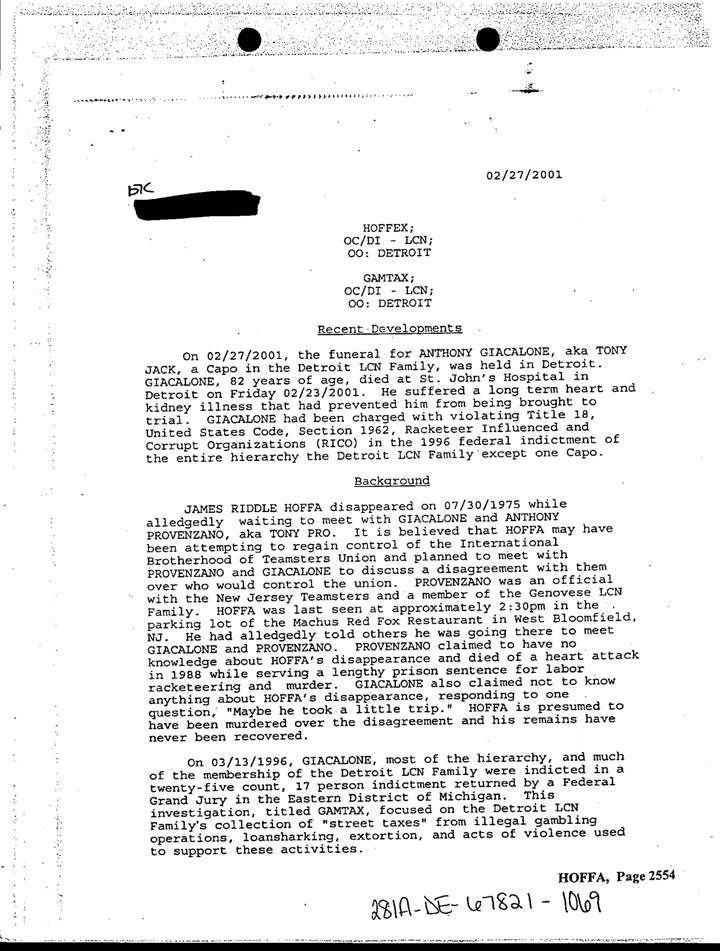
fbi-jimmy-hoffa:FBI-HOFFA-P13-p00171, p. 1Full sizeFBI Vault: Jimmy Hoffa ↗- Released by
- Federal Bureau of Investigation, on the FBI Vault.
- Released
- Posted on the FBI Vault in stages: Parts 1 and 2 on March 23, 2011, Parts 3 to 18 on May 23, 2011, and Part 19 on December 23, 2025.
- What’s inside
- FBI records on Hoffa’s disappearance and the investigation that followed. The Octopus Files holds 756 records from 1,878 pages, taken from Parts 1 to 18. Part 19 is not in the cabinet yet.
- Our copy
- Downloaded from the FBI Vault’s Jimmy Hoffa page (Parts 1 to 18) on October 18, 2026, with the files unchanged.
- Supplements
- None None. Every record comes from the FBI Vault.
- Sources
- FBI Vault: Jimmy Hoffa ↗
At a glance
19482002
Every dated document is drawn. Dates as the catalog records them, counted Nov 19, 2026.
The disappearance of Jimmy Hoffa on July 30, 1975
Detroit agents prepared a case summary for a conference at FBI Headquarters on January 27 and 28, 1976. It says Hoffa left his home at Lake Orion, Michigan, at about 1:10 to 1:15 p.m., stopped at a friend’s business in Pontiac, and left there at 1:30 p.m. for the restaurant; “his whereabouts since that time are unknown.” His wife reportedly got a call from him at 2:15 p.m. The friend told agents that Hoffa called him at 3:30 p.m. to say Giacalone had not shown up for a meeting set for 2:00 (doc fbi-jimmy-hoffa:FBI-HOFFA-P06-p00020, pp. 2, 3, 6, 12).
After hundreds of interviews around the restaurant, the summary counts six people who recalled seeing Hoffa there and five who spoke to him, and none could say how he left. The agents’ assessment was that he “was not physically abducted at the restaurant,” and that he left the area at about 2:45 to 2:50 p.m. (doc fbi-jimmy-hoffa:FBI-HOFFA-P06-p00039, pp. 1–3).
An appointment list taped to the lampshade on his desk, in his handwriting according to his wife, reads “T G 230 Wed 14 Mile Tel Fox Rest Maple Road.” The summary notes that the restaurant is at 15 Mile (Maple) Road and Telegraph, and that it required a suit and tie, which Hoffa was not wearing. It concludes that the meeting “probably never was intended to be inside the restaurant” (doc fbi-jimmy-hoffa:FBI-HOFFA-P06-p00053, pp. 10–11).
Who killed Jimmy Hoffa? What the FBI’s files say
The FBI’s files do not name a killer. In January 1976 the agents wrote that “no evidence has been developed to date which would prove that JRH is either dead or alive,” though they saw no reason he would have disappeared on his own (doc fbi-jimmy-hoffa:FBI-HOFFA-P06-p00053, p. 19). A February 2001 Detroit report says he “is presumed to have been murdered” over a disagreement about who would control the union. Provenzano and Giacalone both claimed to know nothing; Giacalone answered one question with “Maybe he took a little trip” (doc fbi-jimmy-hoffa:FBI-HOFFA-P13-p00171, p. 1).
On motive, the 1976 summary says the theory confidential sources and Teamsters officials had mentioned most recently was that Hoffa “was killed because of his attempts to re-enter Teamster Union politics.” Reports that he had given, or meant to give, the Justice Department information about illegal Teamsters activity had never been substantiated (doc fbi-jimmy-hoffa:FBI-HOFFA-P06-p00053, p. 18).
The summary calls a personal vendetta by Provenzano “very possible,” allows that it may have been someone “totally unknown in this case,” and reasons that a killing, “if there was one,” would have been approved at very high levels of organized crime (p. 19). It also says no further evidence was developed to corroborate the information that Provenzano was to meet Hoffa that day (p. 4).
Was anyone charged? We found no charge for the disappearance in this cabinet’s records; our searches turned up charges only in other cases. On October 4, 2001, the U.S. Attorney’s office in Detroit wrote that it was reviewing the files “to ascertain whether or not there is any basis for seeking to file criminal charges,” and that it was “not possible at this time to determine” whether there was enough credible evidence to support them (doc fbi-jimmy-hoffa:FBI-HOFFA-P16-p00079, p. 2).
Inside the Jimmy Hoffa FBI files
On August 3, 1975, FBI Director Clarence M. Kelley announced that “extortionate communications” about the disappearance had been received, and that the FBI was “assuming investigative jurisdiction under the Federal Extortion Statutes” (doc fbi-jimmy-hoffa:FBI-HOFFA-P01-p00099, p. 1). The Detroit office titled its case file HOFFEX, much as the FBI called the D.B. Cooper hijacking NORJAK (doc fbi-jimmy-hoffa:FBI-HOFFA-P13-p00138, p. 1).
The 1976 summary says 95 people appeared before a federal grand jury in Detroit between September 2 and December 11, 1975, and that 22 invoked the Fifth Amendment and refused to testify, Provenzano among them (doc fbi-jimmy-hoffa:FBI-HOFFA-P06-p00053, pp. 4, 20).
The suspects named in the Hoffa FBI files
The 1976 summary opens with a cast of characters, many of their names withheld (doc fbi-jimmy-hoffa:FBI-HOFFA-P06-p00020, pp. 3–7). Among those it names:
- Anthony “Tony Jack” Giacalone, a Detroit La Cosa Nostra lieutenant who “was reported to have set up” the July 30 meeting and never showed. The summary records his alibi as the Southfield Athletic Club.
- Anthony “Tony Pro” Provenzano, a New Jersey Teamsters Local 560 officer the summary calls a La Cosa Nostra member, who had served time with Hoffa at Lewisburg Penitentiary and reportedly had a “falling out” with him there. He told agents he was in New Jersey that day.
- Salvatore “Sal” Briguglio, a trusted associate of Provenzano, whom a confidential source alleged was involved.
- Frank Fitzsimmons, the Teamsters’ president, listed among “other important figures” as a “reported enemy” of Hoffa.
Being listed is not proof of guilt. In December 1975 a federal judge ordered Salvatore Briguglio to take part in a lineup (doc fbi-jimmy-hoffa:FBI-HOFFA-P01-p00137, p. 1). A witness picked him as the man in a parked car behind the restaurant, after seeing his photograph in a newspaper, and the summary judged that “no conclusive evidence can be drawn at this time” from the eyewitnesses (doc fbi-jimmy-hoffa:FBI-HOFFA-P06-p00053, pp. 13–14).
The maroon Mercury, the scent dogs and the hair
On August 9, 1975, agents seized a maroon 1975 Mercury under a search warrant and found a shotgun in the trunk. Three scent dogs all showed “a strong indication” of Hoffa’s scent in the right rear seat, which their trainers took to mean he had been in the back seat at some time. A September 1975 FBI Laboratory report described a three-inch brown hair from the rear seat with characteristics similar to Hoffa’s, and could not rule out a common source. A substance on the hair reacted positively for blood, but there was too little of it for more tests (doc fbi-jimmy-hoffa:FBI-HOFFA-P06-p00053, pp. 8–10).
The hair was not the end of the forensic work. In June 1998 the Detroit office asked the FBI Laboratory’s DNA unit to test evidence, including material recovered in 1975, for the probability that it came from Hoffa (doc fbi-jimmy-hoffa:FBI-HOFFA-P13-p00119, pp. 1–2). We found no FBI report of the result in this cabinet.
Was it Chuckie O’Brien’s car? The 1976 summary withholds the Mercury’s owner and the reason it was seized (p. 8), so other records make the link. In the FBI’s transcript of a November 7, 1976 60 Minutes interview, Charles “Chuckie” O’Brien, a Teamsters official close to the Hoffa family, disputes an agent’s affidavit about “the car that I had borrowed that particular day.” Morley Safer reads it: probable cause exists to believe O’Brien used the car “to facilitate an abduction” of Hoffa. O’Brien called the agent a liar and offered to take a lie-detector test. Asked who killed Jimmy Hoffa, he said: “I couldn’t answer that ’cause I don’t know” (doc fbi-jimmy-hoffa:FBI-HOFFA-P02-p00005, pp. 2–3). A 1992 Detroit Free Press series kept in the file calls the seized Mercury “the car O’Brien had borrowed” and quotes him insisting Hoffa was “never” in it (doc fbi-jimmy-hoffa:FBI-HOFFA-P10-p00101, p. 10). Probable cause to search is not proof of guilt.
Where is Jimmy Hoffa buried?
No one knows. The FBI’s 2001 report says his remains “have never been recovered” (doc fbi-jimmy-hoffa:FBI-HOFFA-P13-p00171, p. 1). The body search this cabinet describes in detail comes from the same 1992 Free Press series: after two informants claimed the body had been destroyed at Central Sanitation Services, a waste plant in Hamtramck, agents got a warrant and took trained dogs inside. “Nothing was found,” the paper says (doc fbi-jimmy-hoffa:FBI-HOFFA-P10-p00101, pp. 1, 10).
Later digs people still talk about are not in this cabinet. It holds Parts 1 to 18 of the FBI Vault’s 19-part release, and its latest dated records are from 2002; a January 2002 memo still lists the case as pending (doc fbi-jimmy-hoffa:FBI-HOFFA-P16-p00100, p. 1). On July 31, 2025, FBI Detroit said the investigation remains active and asked for information “to assist in moving this case forward” (FBI Detroit ↗).
Example finds
- “Either dead or alive.” Six months in, the FBI’s summary says no evidence “would prove that JRH is either dead or alive,” though agents saw no reason he would vanish by choice.FBI Vault, Jimmy Hoffa Part 06 · doc
fbi-jimmy-hoffa:FBI-HOFFA-P06-p00053, p. 19 · FBI Vault ↗ - “Not physically abducted at the restaurant.” The agents’ account of the Machus Red Fox: six people recalled seeing Hoffa, and none could say how he left.FBI Vault, Jimmy Hoffa Part 06 · doc
fbi-jimmy-hoffa:FBI-HOFFA-P06-p00039, pp. 1–3 · FBI Vault ↗ - The scent dogs and the hair. Three dogs alerted on the Mercury’s right rear seat, and the FBI Laboratory found a hair it could not rule out as Hoffa’s.FBI Vault, Jimmy Hoffa Part 06 · doc
fbi-jimmy-hoffa:FBI-HOFFA-P06-p00053, pp. 8–10 · FBI Vault ↗ - “Maybe he took a little trip.” A 2001 Detroit report says Hoffa is presumed murdered and quotes Giacalone’s answer to one question.FBI Vault, Jimmy Hoffa Part 13 · doc
fbi-jimmy-hoffa:FBI-HOFFA-P13-p00171, p. 1 · FBI Vault ↗ - Prosecutors review the file. In October 2001 the U.S. Attorney’s office in Detroit wrote that it was looking for “any basis for seeking to file criminal charges.”FBI Vault, Jimmy Hoffa Part 16 · doc
fbi-jimmy-hoffa:FBI-HOFFA-P16-p00079, p. 2 · FBI Vault ↗ - “Who killed Jimmy Hoffa?” The FBI’s transcript of Chuckie O’Brien’s 1976 60 Minutes interview, where he calls the agent behind the car affidavit a liar.FBI Vault, Jimmy Hoffa Part 02 · doc
fbi-jimmy-hoffa:FBI-HOFFA-P02-p00005, pp. 2–3 · FBI Vault ↗
How to search the Hoffa files here
Sign up for the alpha. Once your invite arrives, open the Hoffa FBI File cabinet, or tick it with any other cabinets, and search by exact words, with AND, OR and NOT, or by meaning, to find passages about an idea even when the words differ. HOFFEX, a name such as Provenzano, or “Red Fox” makes a good start. Each result lists a record that matched, with the matching passage when there is one; open it to read the record and, where one is available, its original scan. Ask Octopus can also answer a question in plain English, with citations to the records.
Related cabinets: the FBI’s D.B. Cooper, Zodiac Killer and Black Dahlia files, and every cabinet about crime and power.
Questions about the Hoffa files
Who is Jimmy Hoffa?
James R. Hoffa was a former president of the Teamsters union. The FBI’s 1976 summary says he had served time in Lewisburg Penitentiary and in 1975 was trying to return to union politics. He disappeared on July 30, 1975, and has never been found.
What happened to Jimmy Hoffa?
No one knows for certain. The FBI’s 1976 summary says witnesses saw him at the Machus Red Fox restaurant until about 2:45 p.m., and investigators could not establish how he left or where he went. A 2001 FBI report says he is presumed to have been murdered.
Who killed Jimmy Hoffa?
The FBI’s files do not name a killer. The 1976 summary weighed theories, among them a personal vendetta and a killing approved within organized crime, and said the evidence could not show whether Hoffa was dead or alive. None of its suspects is proved guilty in these records.
Why was Jimmy Hoffa killed?
The files give theories, not an answer. The 1976 summary says the motive mentioned most recently by sources and Teamsters officials was his “attempts to re-enter Teamster Union politics.” A 2001 Detroit report says he is presumed murdered over a disagreement about who would control the union.
Was anyone ever charged in the Hoffa case?
We found no charge for Hoffa’s disappearance in this cabinet’s records. In October 2001 the U.S. Attorney’s office in Detroit wrote that it was reviewing the files for any basis to file charges, and that it was “not possible at this time to determine” whether there was enough credible evidence. In July 2025 the FBI said the investigation remains active.
Was Jimmy Hoffa ever found?
No. The FBI’s 2001 report says his remains have never been recovered. The FBI asks anyone with information to call 1-800-CALL-FBI or submit a tip at tips.fbi.gov.
Where can I read the Jimmy Hoffa FBI files?
The FBI posts them on the FBI Vault in 19 parts. This cabinet holds 756 records from Parts 1 to 18, searchable together and cited by document and page.
Background drawn from each release’s official pages and our intake records, written October 24, 2026; counts in the facts above are from that day. The guide draws on the official release pages and on the records in this cabinet, checked November 21, 2026; its cabinet count is from the archive as of November 21, 2026.